
You do not need a free afternoon to make progress with an online course. If you can protect one focused half-hour, you can learn something useful—provided you choose a narrow goal and use the time actively.
The challenge is not usually a lack of information. It is starting a lesson without a clear outcome, watching passively, then waiting too long before returning. A short session works better when it has a beginning, a small target and a clear next action.
What a productive 30-minute session looks like
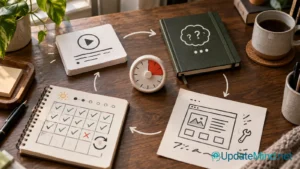
A practical session can be divided into four parts:
Choose one outcome — 3 minutes
Decide what “done” means before you begin. It might be understanding one concept, completing one lesson segment, creating one example or writing down three questions. A narrow outcome prevents you from spending the whole session deciding what to study.
Learn actively — 15 minutes
Watch or read only the section connected to your outcome. Pause when necessary and write a short explanation in your own words. If the lesson includes an example, adapt it to your own work or life instead of only watching it.
Retrieve and apply — 7 minutes
Close the lesson and try to recall the main idea without looking. Then answer a question, solve a small problem, outline a process or demonstrate the skill. Retrieval and application reveal what you actually understood.
Prepare the next session — 5 minutes
Write down where you stopped, what remains unclear and the first action for next time. Leaving a clear starting point makes it easier to return tomorrow.
Short, distributed sessions are also consistent with the spacing effect: learning is generally strengthened when practice is spread across time instead of compressed into one long block. That does not make every short session effective, but it is a strong reason to return regularly.
The one-goal rule
Choose one learning project for the next two weeks. Do not open five courses because all of them look interesting. Pick a skill that matters now and define a small result:
- complete a simple spreadsheet task;
- draft a clearer email;
- understand the basics of a topic;
- practise one feature of a tool;
- create a first version of something useful.
A good goal is specific enough to guide today’s session and flexible enough to survive a busy week.
How to fit learning into a busy day
Look for a repeatable slot rather than waiting for motivation. If you want guided support for building a workable routine, explore Simple Productivity. A morning coffee, a commute without driving, a lunch break or the first quiet period after work can become a learning cue. Protect the session from avoidable interruptions: silence notifications, keep one course tab open and place your notes where you can find them quickly.
If 30 minutes is not available, use a smaller version instead of abandoning the routine. Ten focused minutes can be used to review yesterday’s notes, answer one question or prepare the next exercise. The aim is continuity, not a perfect schedule.
What to do when you miss a day
Do not compensate by doubling the next session. Resume with a small, clearly defined task. Review the last note, retrieve the main idea from memory and continue from the next practical step.
A missed day is information: perhaps the chosen time is unrealistic, the goal is too broad or the lesson requires more concentration than expected. Adjust the plan rather than treating the interruption as failure.
How to know whether you are really learning
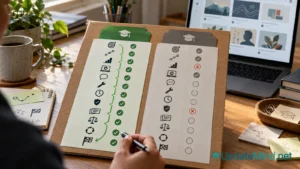
At the end of each week, ask:
- Can I explain the main idea without opening the lesson?
- Can I use it in a small real-world example?
- What can I do now that I could not do before?
- Which part still needs practice?
- Is this course still the best fit for my current goal?
If you can only recognise the material while it is on screen, add more recall and application. If you can explain and use it, your short sessions are producing evidence of progress.
A simple 7-day plan
- Day 1: Choose one outcome and complete the first focused session.
- Day 2: Continue with one lesson segment and write a three-sentence summary.
- Day 3: Retrieve yesterday’s ideas before learning anything new.
- Day 4: Apply one concept to a real task.
- Day 5: Review your notes and identify one gap.
- Day 6: Practise the gap with a small example.
- Day 7: Review the week and choose the next outcome.
You can repeat this cycle with a new outcome each week. The plan is deliberately modest: consistency and active practice matter more than collecting hours.
Choose a practical next step
If you want a more structured way to improve your focus and work habits, explore Simple Productivity. It is an UpdateMind video course and a natural next step for readers who want to turn short study sessions into a more workable routine.
You can also continue with How to Build a Learning Habit That Lasts or compare your options in How to Choose an Online Course That Fits Your Goals.
Final takeaway
Learning online with only 30 minutes a day is realistic when the session has one outcome, includes active recall or application and ends with a clear next step. Start with one skill, one course and one focused session. Then return before the momentum disappears.
Sources for the learning principles:
American Psychological Association — spacing, retrieval practice and evidence-based study strategies: https://www.apa.org/education-career/training/psyclearn-better-learner
Australian Education Research Organisation — managing cognitive load: https://www.edresearch.edu.au/summaries-explainers/explainers/managing-cognitive-load-optimises-learning