
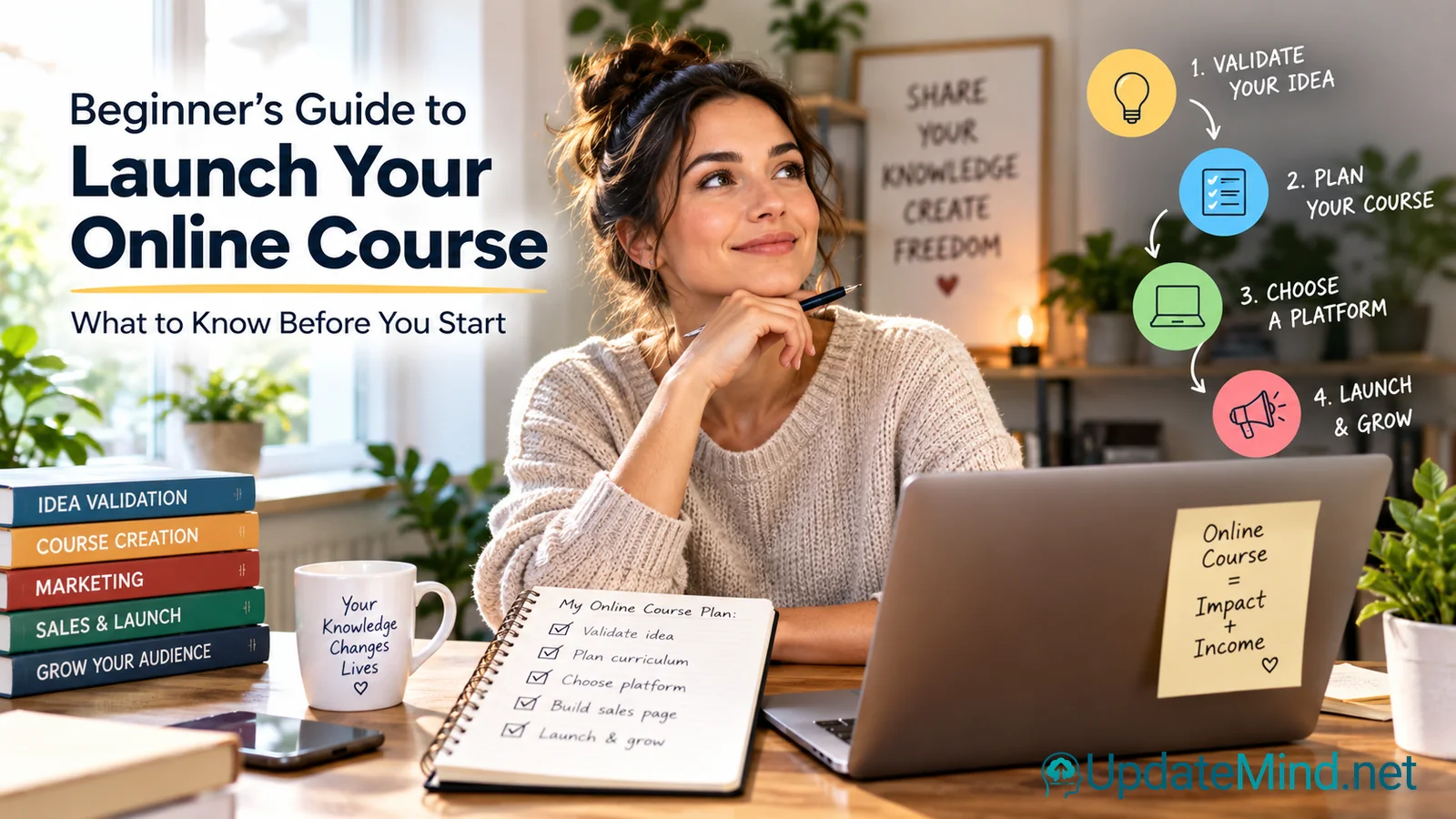
Launching an online course is less about recording dozens of videos and more about solving a specific problem for a specific learner. Before you choose a platform, buy equipment or build a large curriculum, you need evidence that the topic matters to the people you want to teach.
A practical first launch usually follows a simple sequence: define the learner, validate the idea, design the outcome, build only what supports that outcome, prepare the sales and delivery experience, then learn from real students.
Start with the learner, not the course platform
“Anyone who wants to learn” is too broad. Describe the person at the moment they need your course.
Ask:
- What are they trying to accomplish?
- What do they already know?
- What is stopping them?
- What would meaningful progress look like?
- Why would they choose structured instruction instead of free information?
A course for a freelancer trying to launch a first portfolio site should look very different from advanced training for an experienced developer. The clearer the learner, the easier it becomes to choose lessons, examples, terminology and marketing messages.
Define one realistic outcome
A beginner course does not need to solve every problem in a subject. It needs a clear destination.
Compare these two promises:
- “Build a successful online business.”
- “Create and publish a basic portfolio website.”
The second is easier to teach, evaluate and explain. The first depends on many factors outside the course creator’s control.
Write down what a learner should be able to understand, decide or do after completing the course. Then use that outcome as a filter for everything you add.
Validate the idea before building everything
One of the most expensive mistakes is creating a complete course before learning whether the intended audience wants it. Current guidance from major course platforms such as Teachable and Thinkific emphasizes validation before heavy production.
Validation can include:
- interviewing potential learners;
- surveying an existing audience;
- collecting questions from communities or customers;
- creating a waitlist;
- teaching a small live workshop;
- offering a pilot version;
- pre-selling when you can clearly explain what buyers will receive and when.
A pre-sale can provide stronger evidence than likes or poll responses because it tests willingness to pay. However, pre-selling creates an obligation to communicate the scope, delivery schedule, refund terms and any limitations clearly.
Validation does not guarantee future sales. It reduces uncertainty and helps you discover which problem, outcome and language resonate with real people.
If you want to go deeper into idea validation, lean business planning and early-stage decisions, UpdateMind’s The Savvy Entrepreneur course is a useful companion: The Savvy Entrepreneur.
Build the curriculum backward from the outcome
Once the outcome is clear, list the capabilities a learner needs to reach it. Put them in a logical sequence and remove material that is merely interesting but not necessary.
For each lesson, ask:
- What should the learner know or be able to do next?
- Why does this step matter?
- What example or demonstration would make it clearer?
- What should the learner practise?
- How will they know they are ready for the next step?
This approach keeps a first course focused. More lessons do not automatically make a course more valuable.
Do not overproduce your first version
Students need understandable audio, readable visuals, useful examples and reliable access. A first course does not need cinematic production.
Prioritize:
- clear sound;
- legible slides or screen recordings;
- short, well-structured lessons;
- practical examples;
- consistent navigation;
- useful exercises or checklists;
- captions or transcripts where practical;
- testing on the devices your audience is likely to use.
Spend first on removing friction from learning, not on making the course look expensive.
Choose the right delivery model
Online courses can be self-paced, cohort-based, live or hybrid.
A self-paced course offers flexibility and can serve learners at different times, but students need clear navigation and enough structure to keep moving.
A cohort model gives learners a shared schedule and can make interaction easier, but it creates fixed dates and more operational work.
Live teaching gives you immediate feedback and can be useful for an early version of a course. It also requires scheduling and repeated delivery.
A hybrid model can combine recorded material with live Q&A or community support.
Choose the model that best supports the learning outcome and the amount of support you can realistically provide.
Choose a platform after you know what you need
Do not start by comparing dozens of course platforms. First list the capabilities your course actually requires.
Consider:
- video and file hosting;
- checkout and payment options;
- taxes and invoicing requirements for your business;
- coupons or payment plans;
- email integrations;
- quizzes or assignments;
- student progress features;
- community or live-session integrations;
- analytics;
- accessibility;
- transaction and subscription fees;
- data export and ownership;
- customer support.
For creators comparing dedicated course platforms, UpdateMind maintains a direct BetterLinks route to Thinkific: Thinkific. Compare its current features and pricing with your requirements rather than choosing a platform only because it is popular.
Create the sales page around the learner’s decision
A sales page should help a potential student decide whether the course fits them. It should not rely on exaggerated promises.
Explain:
- who the course is for;
- the problem it addresses;
- the intended learning outcome;
- what is included;
- how the course is delivered;
- how much it costs;
- how long access lasts;
- what support is included;
- any prerequisites;
- refund or cancellation terms;
- when a pre-sold course will be delivered.
Use testimonials only when they are genuine and presented in context. Avoid implying that one learner’s result is guaranteed for everyone.
Build an audience before launch day
A course can be useful and still launch quietly if the right people never hear about it.
You do not necessarily need a huge audience. You need a realistic way to reach people who care about the problem you solve.
Before launch, publish useful material around the problem your course addresses. An email list, blog, relevant social audience, professional network, community or existing customers can all become distribution channels.
The goal is not to create hype. It is to let suitable learners understand the problem, your approach and what the course will help them do.
Test the complete purchase and learning journey
Before sending traffic to the sales page, test the experience as if you were a new customer.
Check:
- sales-page links;
- checkout;
- payment confirmation;
- account creation;
- enrollment;
- welcome email;
- course access;
- video playback;
- downloads;
- mobile usability;
- support contact;
- refund or cancellation instructions;
- analytics and conversion tracking.
A polished lesson library does not help if the buyer cannot complete checkout or find the course afterward.
Plan the launch as a short sequence, not one announcement
A launch can include several messages rather than a single “buy now” post.
A simple sequence might be:
- Teach something useful about the problem.
- Explain who the course is designed for.
- Show what the learner will work through.
- Open enrollment.
- Answer common questions and objections.
- Remind interested people before a genuine deadline, if one exists.
- Follow up with new students and begin delivery.
If the course is evergreen, you can still create an initial launch period and then keep enrollment open afterward. If enrollment closes, make sure the deadline is real.
For a guided next step focused specifically on planning and executing a launch, continue with UpdateMind’s Product Launch Masterclass: Product Launch Masterclass.
Support students after checkout
The launch is not finished when payment succeeds.
Decide:
- where students ask questions;
- how quickly you normally respond;
- what technical support covers;
- how learners report broken lessons or files;
- how updates are communicated.
Clear support expectations protect both the learner and the creator.
Use the first launch as a learning cycle
After launch, collect feedback.
Ask learners:
- Where did you get stuck?
- Which explanation or example helped most?
- Which lesson felt unnecessary?
- What did you expect that was missing?
- What can you do now that you could not do before?
Also review practical signals such as sales-page conversion, refunds, support questions, lesson engagement and completion patterns. None of these metrics alone proves course quality, but together they can reveal where the experience needs work.
Improve the course based on recurring evidence rather than adding content simply to make it larger.
A practical pre-launch checklist
Before opening enrollment, confirm that:
- the intended learner is clearly defined;
- the course has one realistic primary outcome;
- you have some evidence of audience interest;
- the curriculum supports the outcome;
- lessons and files have been tested;
- the sales page accurately describes the offer;
- pricing, access and refund terms are clear;
- checkout and enrollment work end to end;
- welcome and access emails work;
- the support process is defined;
- analytics and feedback methods are ready.
Common beginner mistakes
Building before validating
Months of production cannot compensate for weak demand. Test the idea early.
Making the course too broad
A narrower course with a clear outcome is often easier for a learner to understand and finish than a large collection of loosely related lessons.
Choosing software before designing the learning experience
Platform features matter, but they should serve the course model rather than define it.
Treating production quality as the product
Good lighting cannot rescue unclear instruction. Prioritize teaching clarity, examples and practice.
Assuming launch means passive income
Course businesses can require ongoing marketing, customer support, platform administration, updates and learner communication. Treat “passive income” as a business-model claim to examine critically, not an automatic result of publishing videos.
Frequently asked questions
Do I need a large audience before launching a course?
No. A smaller relevant audience can be more useful than a large unrelated one. What matters is having a credible way to reach people with the problem your course addresses.
Should I record the entire course before validating it?
Not necessarily. Interviews, workshops, waitlists, pilot cohorts and clearly structured pre-sales can help test demand before you invest heavily in production.
How long should an online course be?
There is no universal ideal duration. Include enough instruction and practice to support the intended outcome without padding the curriculum.
Do I need expensive recording equipment?
Usually not for a first version. Clear audio, readable visuals and understandable instruction matter more than cinematic production.
Does launching a course create passive income?
Not automatically. Marketing, support, updates, administration and customer service can require ongoing work.
Your next step
Before recording another lesson, write one sentence describing your learner and one sentence describing the outcome your course will help them work toward. Then validate those assumptions with real people.
When you are ready to move from planning to execution, choose the next step that matches your need:
- Learn the launch process: Product Launch Masterclass — Product Launch Masterclass
- Strengthen validation and business fundamentals: The Savvy Entrepreneur — The Savvy Entrepreneur
- Compare a dedicated course platform: Thinkific — Thinkific
Review any platform’s current pricing and features against your own checklist before committing.